The Ultimate Guide to Financial Modeling and Forecasting
In a business landscape shaped by uncertainty, financial forecasting and modeling give leaders the clarity they need to act with confidence.


In a business landscape shaped by uncertainty, financial forecasting and modeling give leaders the clarity they need to act with confidence.
In this article we discuss:
Today's business world is marked by uncertainty and constant change. According to global risk advisory firm Kroll, fewer than one-third of leaders feel equipped to navigate changing pressures such as AI adoption, regulatory shifts, cybersecurity threats, and trade disruptions.
In this landscape, sound financial planning is essential. Companies need the ability to pivot quickly as conditions evolve, and that starts with reliable forecasting. Financial modeling and forecasting combine real-time data, key business drivers, and scenario planning to help leaders make informed decisions and move with confidence.
Financial forecasts predict future financial outcomes based on current and historical data along with business drivers like consumer demand, pricing, cost trends, and broader market conditions. It gives decision-makers a forward-looking view of the business’s financial performance, cash needs, and resource requirements.
Core elements of financial forecasting include:
At the enterprise level, forecasting provides early visibility into changes in revenue, cost patterns, and demand signals. Finance teams can update assumptions as new information arrives and communicate shifts to leaders across the business, who can anticipate pressure points and plan ahead accordingly.
While financial forecasting provides the initial predictions for future performance, financial modeling uses those forecasts to evaluate how different events can impact outcomes. It takes forecasted numbers and runs them through different assumptions—market shifts, pricing moves, hiring plans, capital investments, and other variables—to show how each scenario impacts results.
Core elements of financial modeling include:
Financial modeling is key for connecting strategy to execution. It gives teams a clear line of sight between decisions and outcomes, making it easier to weigh options and commit to a path with conviction. When leaders understand the financial implications of each choice, plans move more seamlessly to actionable direction.
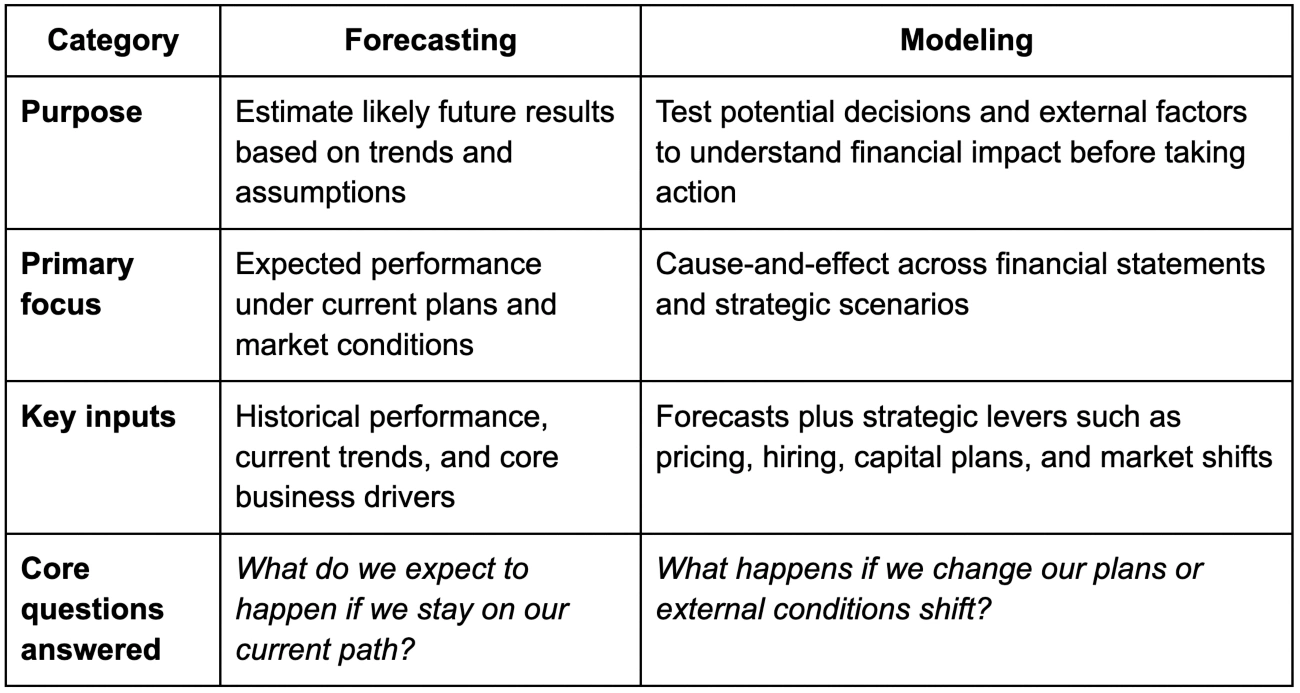
Forecasting estimates future performance based on data, while modeling uses those forecasts to evaluate how decisions will impact outcomes.
Financial forecasting and modeling both support planning and decision-making, but they serve distinct roles. Forecasting estimates future performance based on data and business drivers such as revenue trends and market conditions. Modeling applies structured logic to consider how decisions or external changes affect their outcomes.
Used together, forecasting and modeling give leaders a clear view of where the business is heading and how specific variables will influence results. That link between projection and decision enables planning that is both responsive and grounded in operational reality.
Financial forecasting relies on different types of models to turn data and assumptions into meaningful projections. The model a team selects depends on the questions they need to answer, the data available, and the level of precision required. Here are five key types of financial forecasting model your finance team should be using.
Time-series forecasting analyzes historical values collected at regular intervals to project future results. It separates a series into level, trend, and seasonality, then recombines them to estimate what comes next. It works best when the past is a reasonable guide to the near future and when identifiable patterns repeat.
Forecast = Level + Trend + Seasonality
Example: A beverage brand has monthly sales with a steady upward trend and a summer bump. Current level is 12,000 cases, trend adds 300 cases per month, and July’s seasonal lift averages 1,800 cases.
July forecast = 12,000 + 300 + 1,800 = 14,100 cases. Ops uses this to schedule production and distribution two months ahead.
Regression estimates how a change in one or more independent variables affects a dependent variable. It fits a line or curve that best explains the historical relationship and then uses that relationship to predict outcomes. This is useful when external factors such as price, ad spend, or macro indicators shape performance.
Ŷ = a + bX (simple regression; extend to multiple variables as needed)
Example: A telecom team models monthly net adds (Ŷ) as a function of price discount (X). Historical fitting yields a = 8,000 and b = 120.
With a planned discount of 15, expected net adds = 8,000 + 120×15 = 9,800 subscribers. Finance tests alternative discount levels to optimize growth and margin.
Scenario forecasting builds several coherent futures by changing key assumptions, then quantifies the results for each case. It does not claim one answer; it prepares the organization for a range of outcomes and the actions tied to each.
Outcome under scenario s = f(inputs | s)
Example: A logistics firm models Q4 EBIT under three demand paths:
Leaders pre-commit hiring plans and fuel hedges to each threshold.
Driver-based models link operational levers directly to financial results. They start with the mechanics of the business and roll up to the P&L and cash flow, which makes assumptions explicit and easy to adjust.
Revenue = Volume × Price ; COGS = Volume × Unit Cost ; Gross Margin = Revenue − COGS
Example: A subscription app forecasts next quarter from known drivers:
Quarterly churn ≈ 1 – (1 – 0.04)³ = 11.5%
Ending subs ≈ 200,000 × (1 – 0.115) + 40,000 × (1 – 0.06) = 217,600
Revenue = 217,600 × $12 = $2.611 M
Marketing tests changes in ads or churn to see revenue impact instantly.
ML models learn complex, nonlinear relationships from large datasets and update as new signals arrive. They excel when many variables interact, patterns are shifting, or the granularity is high (for example, SKU-store-day level).
ŷ = f(X; θ) where θ is learned from data
Example: A retailer predicts next-week demand by SKU using features such as past sales, promo flags, web traffic, weather, and local events. The model forecasts SKU A in Store 17 at 148 units. Prior rule-based methods predicted 120 and routinely stocked out. The ML forecast raises the order to 150 and cuts stockouts while holding inventory steady.
CFOs identified forecasting and scenario planning as top transformational areas from AI and machine learning.
Modern forecasting software has transformed how finance teams forecast future revenue growth. Instead of rebuilding manual spreadsheets every month, they now use financial management software systems that can update automatically as business data changes. Forecasts evolve continuously, giving leaders a current view of performance rather than a backward look.
Cloud platforms make this possible by linking finance and operational data in a shared environment. Everyone—from sales to supply chain to HR to operations and more—works from the same numbers to align assumptions and maintain tight version control. Forecasting becomes collaborative instead of sequential.
AI strengthens forecasting even more by analyzing large and varied data sets quickly and learning from changing patterns. It can spot early shifts in demand, pricing behavior, customer activity, and supply conditions before they appear in formal reports. Finance teams receive timely alerts and recommended adjustments, allowing them to respond quickly while keeping planning cycles moving efficiently.
Real-world CFOs are seeing the impact. The Workday CFO AI Indicator Report found that scenario planning and forecasting are top transformational areas driven by AI in finance.
With these tools working together, data moves directly and automatically from source systems and finance can focus on interpreting performance and guiding decisions. Technology doesn’t replace human judgment, but it gives teams the visibility and speed to apply it quickly and when it matters most.
No organization can predict the future, but the right financial forecasting methods and modeling systems give finance teams a clear view of what may unfold and the ability to prepare for several potential outcomes. When these systems rest on strong data and a continuous planning process that evolves over the year, companies stay agile and ready for whatever direction their environments go.
Financial planning then becomes a living and always-on workflow within the finance function where teams can adjust with focus and leaders make decisions with confidence in the path ahead.
Finance leaders are facing increased expectations from both internal and external stakeholders. Download this report to uncover the top five reasons CFOs are moving to Workday to optimize their finance operations.
By mastering skills mapping, predictive analytics, and scenario modeling, HR practitioners are evolving from administrative roles into strategic architects of the future workforce.

More Reading

AI-native, full-document review and redlining doesn’t just speed contract negotiations, it helps fulfill their true purpose.


Agentic AI is coming to finance. Here's how Australian CFOs getting ahead of it are ensuring every autonomous action stays traceable, compliant and audit-ready.


Organizations need agile financial plans, but legacy processes often hold them back. Modernizing corporate financial planning systems is key to staying ahead.