How a Non-Traditional Career Path Gave Hungry Jack's CHRO an 'On-the-Job MBA'
Jenny McKie, Chief People Officer at beloved Australian restaurant chain Hungry Jack's, shares why she's challenging the traditional norms of career progression.

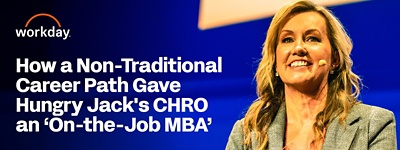
Jenny McKie, Chief People Officer at beloved Australian restaurant chain Hungry Jack's, shares why she's challenging the traditional norms of career progression.
In business, the path to executive leadership is often linear: a series of strategic promotions across a handful of companies, perhaps with a prestigious MBA along the way.
But for Jenny McKie, Chief People Officer at Hungry Jack's, the journey was much more organic. Her career began on the restaurant floor of Hungry Jack's more than 30 years ago, and followed a non-traditional pathway within the organisation, spanning retail, finance, operations, and HR.
"In some ways, I've had lots of different careers within the same brand," Jenny says. "But it's a very demanding business, so no two days are ever the same. You're constantly working on different things and facing different challenges. I love the pace. I think it's what's kept me engaged this long."
At a time when over half (57%) of Australians have been in their current role for less than five years, Jenny's career at Hungry Jack's is a testament to the power of internal mobility, which she says has given her a deep knowledge of all facets of the business. "It feels like I've done an on-the-job MBA," she says.
Jenny's experience offers a unique perspective that challenges the traditional norms of career progression. She shares some great lessons for HR leaders looking to cultivate diverse experiences among their team, and foster a culture where employees feel like their next career move is just down the corridor.
"People have been at the heart of every role I've had," Jenny says. "I always say we're in the business of people. We just happen to sell burgers."
Jenny's career began in 1993 at the heart of the business: on the restaurant floor. After the franchisee sold the store back to Hungry Jack's corporate, she quickly progressed from running a single store to becoming district manager. In 2001, she was asked to relocate from Brisbane to Sydney, to oversee the acquisition of a number of stores.
"After six years in that role, I wanted to try something new," Jenny says. "That's when I came across a position in the finance department, supporting the Chief Financial Officer. It seems like a complete career pivot, but I knew that whatever I did next, I would need that financial grounding."
The two-year stint in finance gave Jenny a deeper understanding of the business' finances, including the impact of day-to-day operational decisions on the bottom line. It was this knowledge that inspired her to transition into operations, first as NSW State Manager and then establishing the new operational excellence team at Hungry Jack's corporate.
"We managed everything from auditing and compliance, to operational processes and customer care," Jenny says. "It was a very lean team in those days, so everyone was wearing multiple hats. But all those years working with restaurants and then the CFO gave me a really good understanding of what we needed to do to be successful."
This unique blend of retail, financial and operations experience would prove vital for future leadership roles, preparing Jenny for the ultimate challenge: Chief People Officer. "People have been at the heart of every role I've had," Jenny says. "I always say we're in the business of people. We just happen to sell burgers."
We often talk about the need for organisations to take a skills-based approach to their workforce — focusing on capabilities and interests over job titles and degrees. Jenny's story is a great example of how organisations can find and nurture the next generation of leaders, by embracing non-traditional career pathways and diverse experiences.
"I think the best thing you can do for your career is stretch yourself by thinking about how you can put yourself in new positions and work with different people," Jenny says. "Most people get that by changing jobs, but I've done it by always looking for opportunities to expand my expertise and contribute in new ways. There's been learning and development the whole way."
65% of Australian business leaders said that digital skills (like proficiency with software and generative AI) is going to be key to future success.
Jenny points out that looking for internal opportunities in different departments or functions is a great way to get a robust understanding of the business, and stand out from the crowd when applying for leadership roles. "It's so important in HR," Jenny says. "Because the goal is really to be a strategic partner to the business, rather than just a support function or cost code."
Jenny is now expanding her skills into the world of agentic AI, as Hungry Jack's introduces a new pilot AI agent called 'Jackie', which takes drive-thru orders. "Jackie has made the crew's lives so much easier," Jenny says. "It means they don't need to multitask, and can focus on all the additional orders that Jackie puts through. They love having the AI agent working with them."
It's something our research shows is top of mind for many Australian business leaders. In fact, 92% told us that leveraging or adopting AI will help them mitigate a skills shortage in their organisation. And when it comes to skills, 65% of Australian business leaders said that digital skills (like proficiency with software and generative AI) is going to be key to future success.
Leading the HR function at Hungry Jack's — which includes teams focused on culture, capability, payroll and systems — has given Jenny a holistic understanding of what really matters in a business. "I have a 'people-first' mindset," Jenny says. "Because I know that if employees have a great experience, then our guests will too."
Of all the skills needed to achieve this, Jenny puts leadership at the top of the list. "That's the key difference between managers and leaders, right? Managers will tell you what to do, but leaders take you on a journey and help you become successful. And I think that's really important," she says.
Developing these high-value skills in Hungry Jack's employees, and giving them visibility into potential career pathways, is something that hits close to home for Jenny. She is currently implementing a framework for each level in the organisation, which incorporates mandatory and self-service training, as well as success measures required for moving into the next role.
"It also helps with succession planning," Jenny says. "So when people say, 'this is the role I want next, how do I get there?' we know how to support them. Having the framework is helping us create a culture where people are encouraged to grow and stretch their skills, in a similar way to what I've done during my career. It's not just left to chance."
"It's been such a journey, and it's definitely had its challenges. But it's the people that have made all the difference."
So what's next for Jenny? Throughout our conversation, one thing was clear: she's not going anywhere just yet. "I've often been asked what my next role might be," she says. "But honestly, I'm really happy where I am. I feel like there's so much more I want to do in this role at Hungry Jack's."
One of these is an audacious goal: for Hungry Jack's to win the ABA Employer of Choice award. Improving the recruitment process, offering better visibility into career pathways, driving learning and development, and embracing agentic AI are all elements of Jenny's master plan to put Hungry Jack's front and centre as a workplace that maximises the full potential of its workforce.
"It's funny, visiting stores as Chief People Offer that I remember opening way back when," Jenny says. "It's been such a journey, and it's definitely had its challenges. But it's the people that have made all the difference. Just having that network of people across the business that I've come to know so well is incredible."
It's a powerful message for HR leaders. At a time when organisations are urgently looking to address talent shortages and skills gaps, people like Jenny McKie who have a deep understanding of both people and business via an 'on-the-job MBA', are not just valuable — they're indispensable.
Over half of business leaders are concerned about talent shortages—and only 32% are confident their organization has the skills needed for success. See how AI is transforming skills management in this report.
Workday Elevate Online is now streaming, featuring 30+ sessions packed with the latest AI innovations and industry insights. Discover the trends, challenges and opportunities facing HR, finance and IT, and learn from industry leaders who are using AI to drive new levels of efficiency, innovation and growth.

More Reading

See how Workday’s L&D team used Sana Learn to increase course completion, cut build times, and localize global training with AI.


Workday is honoured to be recognised as a Leader in the 2026 Gartner® Magic Quadrant™ for Talent Acquisition as it continues to help organisations hire faster, improve candidate experiences, and scale recruiting with AI-powered agents.


As the Federal Government introduces a more integrated tertiary education system, employers have an opportunity to shape a new generation of job-ready graduates.