5 Lessons from Alex Depledge on Scaling Without Losing Your Soul
Scale your business without losing its soul. Learn 5 key lessons on data, communication, founder evolution, and talent acquisition to build a lasting company.

Scale your business without losing its soul. Learn 5 key lessons on data, communication, founder evolution, and talent acquisition to build a lasting company.
You can also listen to this episode in audio format on Apple Podcasts and Spotify.
In the world of entrepreneurship, it’s easy to romanticise the early days. We love the stories of ideas first scribbled on coffee shop napkins, the first few hires when you see other people buying into your idea, and the scrappy energy of a team working late into the night to solve problems over a shared desk.
But as any leader will tell you, the adrenaline of the startup phase eventually hits a wall. In the latest episode of the Go for Growth Podcast, I sat down with Alex Depledge, the co-founder behind UK success stories Hassle.com and Resi, to discuss the phase where so many businesses come unstuck: The Messy Middle.
The transition from a 20-person startup to a 500-plus person scale-up is as much a psychological challenge as it is an operational one. "I had a bit of a crisis about four years ago," Alex admits candidly. "I just didn’t know if this was me. I had to really grow up."
Here are five key lessons Alex shared on how to navigate the messy middle, without losing what makes your business special.
"People leave companies all the time. If someone’s been here for three or four years and they want to move on, it doesn't have to be a 'what’s wrong with the company' moment."
In a startup, communication happens by osmosis. You’re all in the same room; you hear the sales calls, you see the bugs, and you know the strategy. But as you scale, that organic connection vanishes.
Alex identifies "comms" as the very first thing to crack. "The communication doesn't run up and down the business," she explains. "What’s going on on the front line is not making it up to you, and what you’re saying is not making it down to the ground level."
This gap is where culture goes to die. When employees aren't clear on the strategy or don't know the "why" behind their tasks, they become disengaged. To survive the messy middle, you have to move toward intentional, structured internal communication. It’s about ensuring that the "grunts and grumbles" from customer-facing teams reach the leadership, while the view from the top is translated into every department.
One of the most profound metaphors Alex shares is the idea of "driving a car at night without headlights." In many scaling businesses, there is a flurry of tactical action, emails sent, calls made, code shipped, but no one’s got their eyes on the road.
The solution? Every single person in the business must own a KPI or a data goal.
"I see the same thing over and over again where there's a lot of tactical action but none of it is rolling up to a strategic vision," says Alex. By giving every individual a piece of data they’re responsible for, you provide them with a sense of purpose. Whether it’s a sales target or a customer satisfaction score, that data becomes their "headlight." When everyone has their own light, the entire company can see the road ahead.
We’ve all seen them: bland corporate values like "Integrity" or "Excellence" emblazoned on office walls but ignored in practice. Alex argues that for a scale-up values must be actionable.
At Resi, the values aren’t just words; they’re behaviors: Do more with less, Drive it, and Deliver with love. To keep these alive, Alex introduced "The Allstar", a Slack channel where any employee can nominate a peer for living a value.
"You can put them on a wall, but how do you make sure they’re being constantly lived?" Alex asks. The answer is peer-to-peer recognition. When you hear other people, not just the senior leadership team, calling out these behaviors, the values move from a policy document into the company’s DNA.
Perhaps the most difficult part of the messy middle is the personal transition for the founder. The skills required to thrive in chaos are rarely the same skills required to lead a structured organisation.
Alex describes her own "brutal" self-assessment, which led her to hire a performance coach. She had to face the reality that she wasn't an expert in everything and needed to surround herself with people who could fill those gaps.
This evolution also requires you to get used to people leaving your business. In the early days, a resignation can feel like a personal betrayal. In a scale-up, it’s a natural progression. "People leave companies all the time," Alex notes. "If someone’s been here for three or four years and they want to move on, it doesn't have to be a 'what’s wrong with the company' moment."
Scaling often leads businesses to hunt for expensive corporate hires. Alex takes an unconventional approach: finding high-potential individuals in non-traditional places.
She shares the story of one employee who she found fixing scooters at Halfords. Recognising his talent for customer service and "mentality for coding," Resi put him through boot camps. Today, he leads their AI efforts. From waitresses in Brixton to cashiers in Newcastle, Alex looks for the "DNA" of a worker rather than a polished CV.
"When you don't have the capital, all you have is your time," she says. By investing time into "growing your own" talent, you create a profound sense of loyalty that corporate hires rarely match. This philosophy allows Resi to scale its tech while maintaining a team with an average tenure of over five years.
The journey through the messy middle is undeniably painful. It requires a willingness to admit what you don't know, and the courage to trade the thrill of chaos for its less glamorous counterparts: process, structure, and sustainable success. But for those who get it right, the reward is a business that isn't just a startup anymore, it's a legacy.
Alex argues that the UK's economic future depends not on shopkeepers or massive corporates, but on the businesses that successfully cross the divide from small to large. "If your business is not over 20 people, you’re not contributing to the UK GDP in terms of impact," Alex claims. We have to let go of our fear of failure, she says, and realise that scale-ups are the engine of national growth.
We’re in a critical leadership moment: Can organisations redesign work, transforming productivity into real business impact and deeper human connection? The Beyond Productivity report breaks down where AI is really creating value (and where it’s quietly destroying it).
More Reading

Together, we will help organizations build the HR function of the future, not just dream about it.

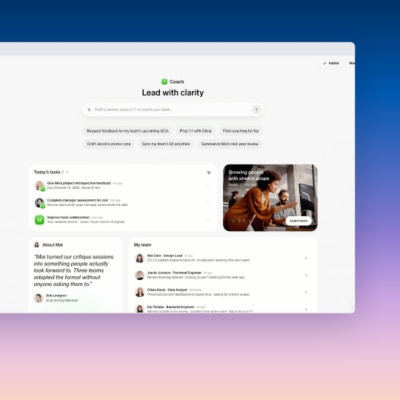
Sana Coach brings performance, feedback, sentiment, and leadership coaching into one connected, conversational experience, moving talent development from episodic HR tasks to always-on guidance. Watch a demo.


Workday Brings Employee Benefits Into The Agentic Era
We're launching Workday Total Benefits, the next step in our vision for AI-powered benefits, where AI agents guide every employee to the right benefit decisions and handle the administrative work behind them.