Beyond Productivity: How Leaders Can Drive Real ROI With AI
Workday research reveals that we’re in a critical leadership moment: Can organizations redesign work, transforming productivity into real business impact and deeper human connection?


Workday research reveals that we’re in a critical leadership moment: Can organizations redesign work, transforming productivity into real business impact and deeper human connection?
What if the biggest barrier to your company's AI success isn't the technology itself, but how we’ve structured the work around it?
As global leaders gather in Davos for 2026 under the theme “A Spirit of Dialogue,” the conversation is shifting from what AI can do to how it’s actually delivering value inside organizations.
At Workday, we recently asked thousands of professionals how AI is delivering real ROI and how it’s actually changing their average work day. What we found reveals both huge momentum and a massive opportunity most organizations are missing.
The key finding of our research: 85% of employees say AI is already helping them save time. But nearly 40% of that time is being spent reviewing, fixing, and reworking AI outputs.
Nearly 2 weeks of time per employee per year is lost to checking and re-working AI outputs.
This isn't a failure of AI. It’s a leadership moment. Because the real question isn’t whether AI can boost productivity. It’s whether leaders are ready to redesign work so that productivity turns into real business impact and deeper human connection.
Our latest research, Beyond Productivity: Measuring the Real Value of AI, shows we’ve reached a turning point.
AI is doing what we asked it to do. It’s allowing us to finish tasks faster. But speed alone does not create value. What matters is what happens after the time is saved.
Right now, only 14% of employees say they consistently get clear, positive results from their AI use. That is not because the technology isn’t working. It is because most organizations are still stuck in deployment mode, not transformation mode.
As Aashna Kircher, Workday’s Group General Manager, puts it:
“Individual tasks are getting faster, but organizational outcomes are not improving at the same rate. Instead of freeing people to do more meaningful work, a surprising amount of time is cycling back into rework, oversight, and burnout.”
That gap between effort and impact is the real ROI problem. And the potential for leaders is to fully transform their organizations for the AI age. This is not hyperbole. Our research proves it.
Right now, only 14% of employees say they consistently get clear, positive results from their AI use.
We see it most clearly among what we call “Low-Return Optimists.” These are heavy AI users who believe in the technology and rely on it every day. They should be driving the biggest productivity wins in your organization. Yet 77% of them say they still have to audit AI output just as carefully as human work.
That means a huge share of AI’s promised time savings is being swallowed by checking, fixing, and second-guessing.
And that is the opportunity hiding in plain sight. When leaders rethink productivity, accountability, and how work flows between humans and machines, that auditing time turns into innovation time.
That is where efficiency becomes growth, where AI starts to deliver real ROI, not just faster check marks on employee task lists.
According to our president of EMEA, Angelique De Vries, “productivity on its own cannot secure prosperity.”
To drive real ROI, we have to move past the belief that technology alone fixes productivity. This is not a software problem. It is a people and operating model problem.
Aashna advises us to focus on the value created, not just hours saved, because “the real question is not what AI can do, but who we want people to become in an AI-powered world.”
And Workday data shows exactly where leaders need to focus.
In 89% of organizations, fewer than half of roles have been updated to reflect AI capabilities. That means people are still being managed as if the work never changed.
The opportunity is to move from rigid structures to an organization focused on collaboration and connection, where AI handles routine tasks and people focus on what matters most: driving value for customers.
While 39% of leaders have increased technology spending, only 30% have increased investment in workforce development.
Real ROI happens when your tech strategy and your people strategy move together.
Employees ages 25–34 are your most active AI users, but they are also carrying 46% of the rework burden.
With clearer guardrails, updated roles, and better training, that rework can turn into creativity, innovation, and leadership.
In the age of AI, leadership becomes the ultimate human advantage.
AI can optimize schedules.
AI can summarize data.
AI can even suggest next steps.
But it cannot build trust.
It cannot resolve conflict.
And it cannot create the shared belief that makes teams move together.
That is the real paradox of AI. The more we automate the busywork, the more we depend on human connection, judgment, and collaboration.
As leaders gather in Davos under the banner of a “Spirit of Dialogue,” the opportunity is clear. Use AI to clear the noise, so people can do what only people can do: think, create, connect, collaborate, and decide what matters.
The winners in the AI era will not be the companies with the most algorithms.
They will be the ones that use AI to unlock the most human potential.
This article only scratches the surface. The full Beyond Productivity report breaks down where AI is really creating value (and where it’s quietly destroying it) across:
Regions and industries
Leadership vs. frontline experience
High-performing vs. high-friction organizations
If you want to know where your company is leaving ROI on the table, this is the map.
More Reading

Together, we will help organizations build the HR function of the future, not just dream about it.


We’re delivering lawful, headless access to HR and finance.

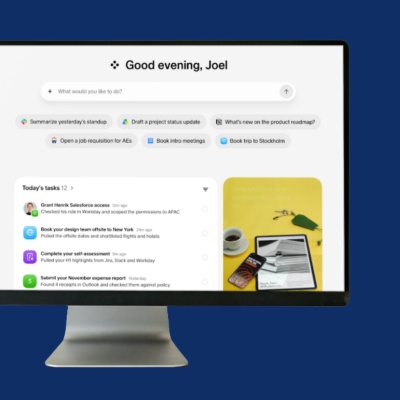
At Workday Rising today, we're introducing new Sana capabilities that help employees get work done across HR, finance, and IT by coordinating the right agents, tools, and people behind the scenes. Watch a quick demo.