Which jobs will be replaced by AI – and which won’t
Which jobs will AI actually take over – and which won’t? This article debunks myths and shows which roles are disappearing in, which are changing, and where human skills remain irreplaceable.


Which jobs will AI actually take over – and which won’t? This article debunks myths and shows which roles are disappearing in, which are changing, and where human skills remain irreplaceable.
There is a lot of talk about AI. Mostly in grand terms: disruption. Job killer. Silver bullet. As is so often the case, the truth lies somewhere in between. We are facing a profound transformation of the world of work. But not every change is a loss. And not every form of automation spells the end of a profession.
The reality is: AI is changing work. It is not replacing it across the board. Some tasks are disappearing, many are evolving. And some are even gaining in value.
The debate is often characterised by extremes. On the one hand: the fear of mass unemployment. On the other: the promise of a more efficient, fairer world of work. In fact, the data paints a nuanced picture. Only 11% of jobseekers expect AI to have negative consequences for their careers. Almost 60% even see advantages. This confidence is remarkable – especially as the UN warns that up to 40% of all jobs worldwide could be affected.
So why are we so calm? Perhaps because there is significant investment in professional development here. Perhaps also because many companies view AI not as a replacement, but as a complement to human skills. That is a crucial difference.
What ‘AI’ can do is not uniform. It involves various technologies with different effects.
1. Generative AI (e.g. ChatGPT):
It generates text, analyses data and writes code. Particularly affected: clerical professions and administrative tasks. But highly skilled jobs – for example in the media or in software development – are also feeling the impact of this change. AI isn’t taking their jobs away. It’s changing them. Programmers are becoming system architects. Reporting is becoming faster, more analytical and data-driven.
2. Robotic Process Automation (RPA):
It takes over rule-based, repetitive tasks – for example in finance or HR. But here too, the jobs aren’t disappearing; they’re shifting. Those who used to enter data are now analysing processes. RPA takes the strain off – provided companies create new areas of responsibility.
3. Machine Learning (ML):
It recognises patterns, makes predictions, learns from experience. ML is fundamentally changing work, particularly in data analysis. Many entry-level jobs in this field are being replaced. At the same time, there is a growing need for specialists who can explain what algorithms actually do – and what they do not.
Entire occupational groups are not disappearing. It is tasks within jobs that are susceptible to automation. Particularly at risk are activities that…
Examples:
It is striking that most of these tasks can be clearly described and are often repetitive. They can be standardised – and therefore also automated..
No one is safe. But a lot of tasks will remain human – at least for the time being. These include…
The distinction, therefore, is not between ‘cognitive’ and ‘manual’. Rather, it is between ‘routine’ and ‘adaptive’. It is not the job title that matters, but the nature of the work.
A key point: many jobs will not be replaced, but transformed. This is called “augmentation”. AI takes over the routines – humans handle the exceptions, strategy and communication. This is more demanding. And it increases the pressure.
Those who use AI today often have more responsibility, more deadlines, and a greater flood of information. That is not always a relief. New skills are needed: in using tools, but also in managing stress.
Academic professions used to be considered secure. Not so today. Whilst they are rarely fully automatable, many sub-tasks are. An example: lawyers still need to argue cases and pass judgement. But AI can produce initial drafts, carry out research and generate standard texts more quickly.
It’s similar in medicine. Diagnosis remains a human task – but what about image analysis or documentation? Here, AI is often more precise and faster. So anyone who thinks that a degree alone protects against automation is mistaken. It all comes down to the combination: specialist knowledge, digital literacy, ethical judgement.
It won’t work without learning. According to studies, 85% of employers want to invest in internal training. This is because almost 40% of the skills in demand today will be obsolete by 2030.
Two types of skills are in demand:
It is interesting to note that formal qualifications are becoming less important.
What is in demand are demonstrable skills – whether acquired through bootcamps, micro-certificates or on-the-job learning. Learning is becoming lifelong. And modular.
One problem remains: access to AI and further training is unevenly distributed.
A new digital divide is looming here – not between humans and machines, but between those who use AI and those who do not (or cannot). Those who have access benefit. Those who do not fall behind.
Many companies use AI – with varying results.
Industry:
The automotive sector is investing heavily in autonomous driving and process automation. Siemens, BMW, Bosch – they all rely on AI. Yet here too it is clear: it is not just about technology. When markets shrink, jobs are lost – despite AI. Productivity helps, but does not replace strategic direction.
Services:
In customer service, an IAB study has shown: AI-supported training makes new employees better more quickly. Satisfaction is rising. But two in ten felt more closely monitored. That, too, is part of the truth.
SMEs:
Here, the use of ChatGPT and other tools is growing. Yet access is often still limited. Many managers are optimistic – but only a third want to give all employees access to AI. That is not enough.
AI will not replace everything. But it is changing everything – step by step. The jobs that remain will look different. And they will demand more. More skill. More thinking. More humanity.
What we need now is a realistic perspective. No alarmism. But no romanticisation of technology either. It is about actively shaping AI – through education, regulation and bold companies.
Those who engage with AI early on, understand it and use it sensibly, will be better placed. Those who strengthen human skills – communication, ethics, creativity – will remain in demand.
And those who build systems that empower people, rather than replace them, create not only more productive but also fairer work.
Discover how Workday’s innovative solutions can help you navigate the evolving AI-powered world of work and future-proof your workforce.
The new EU directive on pay transparency requires companies to be more open – and could trigger a profound cultural shift in the world of work.

More Reading

Together, we will help organizations build the HR function of the future, not just dream about it.


We’re delivering lawful, headless access to HR and finance.

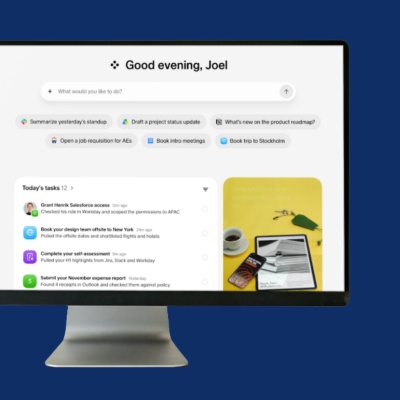
At Workday Rising today, we're introducing new Sana capabilities that help employees get work done across HR, finance, and IT by coordinating the right agents, tools, and people behind the scenes. Watch a quick demo.