From Pilots to Agents: The Executive Roadmap to Operational AI
How companies transition AI agents from pilot to production: clarify governance, standardise workflows, demonstrate value and scale. With clear KPIs and a roadmap.


How companies transition AI agents from pilot to production: clarify governance, standardise workflows, demonstrate value and scale. With clear KPIs and a roadmap.
For business and technology leaders, the conversation around artificial intelligence has shifted decisively. What was once a horizon topic is now a boardroom imperative. Autonomous, agentic AI systems are moving from theoretical promise to practical infrastructure, reshaping how organizations orchestrate complex workflows, allocate talent, and compete.
Yet while some companies are rapidly scaling AI agents to drive systemic value, many remain confined to small-scale pilots that consume resources without transforming operations. The sticking point is not the technology itself. It is governance. The ability to define roles, manage workflows, and establish clear accountability now determines who leads—and who falls behind.
Many pilots begin with excitement but lack a strategic anchor. They are often framed as technical experiments rather than operational upgrades, disconnected from core business drivers. This structural flaw makes scaling nearly impossible.
Three recurring issues stand out.
First, unclear ROI. Too many initiatives rely on abstract success metrics instead of measurable outcomes tied to profit and loss. Projects with explicit economic value are 60% more likely to secure executive sponsorship—a prerequisite for moving beyond experimentation.
Second, funding and ownership gaps. Pilots often sit within innovation labs or IT teams, isolated from Finance, Operations, or business units. Even if the technology works, the absence of shared budgetary responsibility prevents institutional momentum.
Third, fragmented governance. Without standardized processes, different units develop siloed rules and escalation paths, multiplying risk and complexity. Over 60% of organizations still lack an enterprise-wide approach to generative AI, creating inconsistent risk management and making scale unmanageable.
The result is organizational inertia—not technological failure. While some companies debate internal ownership models, competitors are already orchestrating end-to-end workflows with agentic systems, achieving speed and cost advantages that compound over time.
Executives often focus their risk calculus on technical factors such as model accuracy or bias. These matter, but they are not the primary obstacle to scaling. The real vulnerabilities arise in unmanaged workflows and unclear human-AI handoffs.
When autonomous systems operate in ambiguous environments, errors typically stem from process gaps rather than algorithmic flaws. If an agent fails to escalate a low-confidence decision or operates under different governance rules than another team’s agent, accountability fragments. This creates legal, operational, and reputational liabilities.
Around 19% of Fortune 500 companies already use autonomous AI in business-critical processes.
Establishing a human-AI collaboration contract is essential. Humans bring contextual judgment and ethical reasoning; agents bring speed, consistency, and data processing power. Defining clear boundaries—what agents can do autonomously, when they must escalate, and who is responsible—forms the backbone of operational safety.
Early adopters show that once governance foundations are in place, scaling agentic AI generates measurable returns.
More than half of CFOs report that autonomous digital labor is reshaping how ROI is evaluated, shifting from narrow IT metrics to systemic business outcomes. Nearly 90 % of executives already see tangible benefits from their AI investments, with returns often reaching five to ten times the initial spend.
The biggest gains emerge when companies move beyond horizontal “co-pilots” toward vertical, cross-functional orchestration. Around 19 % of Fortune 500 companies have already deployed agentic AI to automate mission-critical processes, such as financial reconciliation or legacy modernization.
The lesson is clear: competitive advantage comes not from marginally faster individuals, but from systemically faster organizations.
Transitioning from pilot to production requires disciplined execution. Leading organizations follow a structured roadmap that aligns technology, governance, and business strategy.
Phase 1 — Foundation and Proof of Value (90–180 days).
Executives begin by setting a clear strategic “North Star” and identifying high-impact workflows with direct P&L implications. Data readiness is addressed upfront: without unified, reliable data, even the most advanced agent will fail. Targeted pilots focus on structured, high-volume tasks and are measured against SMART KPIs to prove value quickly.
Phase 2 — Enterprise Integration and Standardization (6–12 months).
Proven workflows are scaled, legacy systems integrated, and governance standardized across units. Escalation paths and contextual handoffs are embedded into operational logic, ensuring consistency and accountability. Architectural flexibility becomes a priority, separating agentic logic and proprietary data from underlying vendor models to maintain sovereignty in a fast-moving technology landscape.
Phase 3 — Continuous Optimization and Hyperautomation (1 year+).
Once governance is mature, organizations focus on continuous performance optimization. Automated dashboards, human-in-the-loop monitoring, and forensic traceability enable rapid course correction and risk management. Strategic expansion targets high-level orchestration use cases that fundamentally reshape how the organization operates.
Governance is not a compliance formality, but rather a strategy.
Leaders seeking to explore these frameworks in practice will find valuable discussions at Workday Rising EMEA in Barcelona, where dedicated sessions such as Workday Masterclass on Governance Strategies for Agentic AI in Enterprise unpack how governance architectures can accelerate the transition to operational AI—without the detours of endless experimentation.
Moving beyond pilots also requires changing how success is measured. Technical outputs like system uptime are necessary but insufficient. Executives must demand business-relevant outcomes.
Key performance indicators should cover four dimensions:
Efficiency and throughput: Reducing end-to-end cycle times in complex workflows.
Accuracy and risk: Minimizing errors in high-stakes processes through reliable escalation.
Cost and ROI: Quantifying cost avoidance and productivity gains tied to P&L.
Adoption and trust: Tracking employee usage and trust levels, since cultural acceptance is critical for sustainable scale.
If agents consistently miss accuracy targets or employees bypass them due to mistrust, governance interventions—not new models—are needed.
The decisive factor in the next phase of AI adoption will not be model quality alone, but operational architecture and governance. Organizations that treat agentic AI as a workflow re-engineering exercise—anchored in P&L impact, legal accountability, and intelligent human-AI collaboration—are already converting technological potential into strategic advantage.
For those still navigating the transition, the path forward is clear and actionable. Establish a governance spine, focus on high-impact workflows, measure what matters, and scale deliberately.
And for executives looking to deepen their understanding, Workday Rising EMEA in Barcelona offers an opportunity to learn directly from those already operationalizing agentic AI at scale. The competitive landscape is evolving quickly. In this race, governance is not a compliance formality—it is the strategy.
More Reading

Together, we will help organizations build the HR function of the future, not just dream about it.


We’re delivering lawful, headless access to HR and finance.

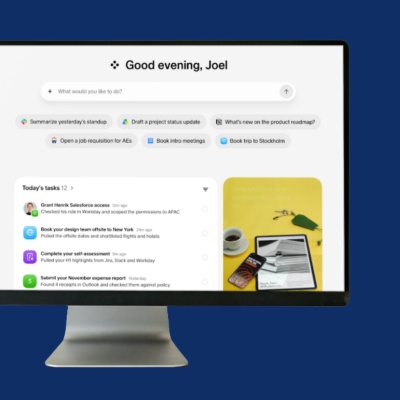
At Workday Rising today, we're introducing new Sana capabilities that help employees get work done across HR, finance, and IT by coordinating the right agents, tools, and people behind the scenes. Watch a quick demo.