A Decade of Connection: The People Leadership Summit Story
Reflecting on a decade of the People Leadership Summit—from catching culture smoke signals to meeting the AI moment.


Reflecting on a decade of the People Leadership Summit—from catching culture smoke signals to meeting the AI moment.
In this article we discuss:
It’s hard to believe it’s been a decade since we first gathered a group of directors at an airport hotel near SFO for Workday’s very first People Leadership Summit (PLS). What started as a one-time experiment became a defining tradition that anchors our approach to leadership.
Each year, PLS welcomes first-time people leaders at Workday to gather and hear directly from our executive team. Through workshops, panels, and keynote speeches, people leaders learn how they can activate our core values: employees, customer service, innovation, integrity, fun, and profitability. The summit equips them not only to model our values, but to develop their leadership skills and learn practices that enable the success of every Workmate.
What started as a one-time experiment became a defining tradition that anchors our approach to leadership.
To understand the significance of PLS to Workday’s culture, it’s helpful to look back to 2016. At the time, the company was growing at a very rapid pace, and while employee sentiment scores were still very high, we started seeing smoke signals in our data—those tiny dips—that told us something was shifting. Our rating on Fortune’s Top 100 Companies to Work For list had dropped, and there was an uptick in negative feedback on sites like Glassdoor.
This shift was particularly concerning because Workday had always prided ourselves on our commitment to people and culture. That commitment was so hands-on that our co-founder and CEO Aneel Bhusri personally interviewed the first 500 employees. It was a powerful way to anchor our cultural DNA, but as we became a global enterprise, it became harder to scale that intentionality across the entire organization.
By digging into our data, something became very clear: we didn't have "bad" managers; we just had an influx of new managers to the company who weren’t connected to our values yet.
When my team and I brought our analysis to Aneel, he didn’t hesitate. We weren’t even halfway through the deck before he turned to me and asked, “What are we going to do about it?” Fortunately, we’d come prepared with ideas. The one that resonated immediately was a leadership summit that would bring together leaders from across the company and fully immerse them in Workday’s culture and values.
During that inaugural year, we gathered 450 Directors from across the globe, and as the sessions unfolded, you could practically see the sparks going off in the room. There was this palpable energy as leaders realized they weren't just there to learn management tasks, but to carry forward a legacy.
The experience was so powerful, and the feedback so positive, we decided to make it an annual rite of passage for every new people leader at Workday. While some of these leaders may have managed teams in other organizations, we believe it’s important to ground them in what it means to lead here; and what’s distinct about our approach to leadership.
PLS is a multi-day experience designed to accomplish three clear goals:
Role Model Our Values: Show how we bring our values to life through leadership behaviors, decisions and actions.
Enable team performance: Share strategies and tools that help our managers build high-performing, highly engaged teams
Grow as a leader: Empower participants to expand their influence and impact.
Attendees don’t just listen to senior and C-suite executives; they’re invited into real conversations where stories take center stage. Leaders talk about the moments that tested them, the mistakes that humbled them, and the choices that changed the way they lead. Through these personal stories and hard-earned lessons, we get practical insight into how we show up today, how we want to lead going forward, and what we can reasonably expect from one another as Workday leaders.
In hallmark sessions like “Navigating Difficult Conversations” and “Leading with Empathy,” we work through real scenarios and real behaviors. The summit is an immersive look at our values in action, and an investment not in spreadsheets or slide decks, but in our people and the everyday actions that drive our shared success.
With the exception of one year during the pandemic, we’ve held every PLS in person. There’s just something about being together—the exchange of ideas, the hallway conversations, the chance encounters—that you simply can’t replicate on a screen. It’s a significant investment of time and resources, but it’s one we deeply believe in, because those in-person moments are where connection, insight, and lasting culture truly take root.
While much of the content at the People Leadership Summit is evergreen, we continuously evolve the experience to meet the moment. Over the years, we’ve shifted our focus to help leaders navigate the most pressing challenges of the time. For example, during the pandemic, we placed even more emphasis on leading with empathy and resilience.
Today, the defining opportunity for Workday and our leaders is AI—both in how we lead with technology and how we adopt it internally. So we’ve adapted the agenda to reflect that. This year’s summit includes a session titled “Leading with Connection in the Age of AI,” where leaders will explore their own AI journeys and learn how to help their teams move from anxiety to clarity.
Leadership requires constant adaptation. PLS has evolved alongside this reality, ensuring that what we offer is not just timeless in principle, but timely in practice—equipping leaders for the world they are leading in right now.
Today, the defining opportunity for Workday and our leaders is AI—both in how we lead with technology and how we adopt it internally.
One question I often hear from other CHROs is, “How has Workday kept its culture strong from start-up to Fortune 500?” My answer, in large part, is the People Leadership Summit. Almost everyone says, “That’s a great idea,” but very few actually do it. It can be a hard sell to a CEO to fly in hundreds of leaders just to talk about values and culture, but our results have shown it’s one of the best investments we make.
After those first summits, we saw a real shift. Our employee health metrics improved, and our place on the Fortune list rose. It confirmed what we already sensed: when we step away from the day-to-day and invest in the person behind the leader, the business and the culture follow.
The most rewarding part of PLS is the ripple effect. I’ll never forget an email from a Workmate who said, “I don’t know what happened during those few days away, but my manager is showing up completely differently now.”
Looking back on a decade of PLS, what stands out most is our leaders’ growth. I see people leave with more clarity of purpose, a stronger connection to our values, and greater confidence in themselves and their teams. For me, PLS isn’t just an event. It’s a reminder of why this work matters: helping people grow, protecting our culture, and making sure every Workmate feels supported by their manager. As AI reshapes how we work, that commitment matters more than ever, and PLS is one of the most powerful ways we keep it alive.
More Reading
Together, we will help organizations build the HR function of the future, not just dream about it.

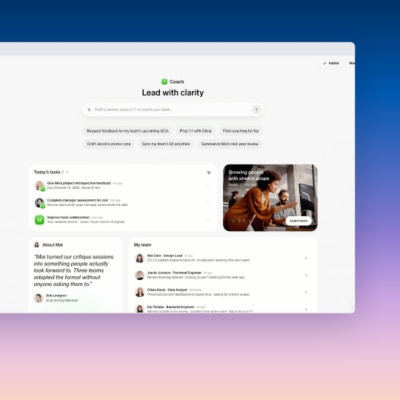
Sana Coach brings performance, feedback, sentiment, and leadership coaching into one connected, conversational experience, moving talent development from episodic HR tasks to always-on guidance. Watch a demo.

:Square?wid=400&hei=400)
There was no top-down mandate, pilot program, or central engineering project. Instead, HR practitioners spotted a friction point in their own workflows and used Sana to fix it themselves.