HR 2030 Is Coming. Here's Why The Josh Bersin Company is Partnering With Workday.
Together, we will help organizations build the HR function of the future, not just dream about it.


Together, we will help organizations build the HR function of the future, not just dream about it.
I've spent more than two decades studying how companies manage people, and I've watched plenty of technology-based transformations capture our attention.
This one is really different.
By 2030, I believe HR will look less like a service function and more like the operating system for business growth. That's why I'm more excited about this moment than at any time in my career—and why The Josh Bersin Company is partnering with Workday to build a new playbook.
Here's why I think this is the big one.
By 2030, I believe HR will look less like a service function and more like the operating system for business growth.
For all the lofty AI predictions, companies are becoming more dependent on people. Driven by a low birth rate and aging population, labor is getting scarcer, not more abundant.
Our research, built on U.S. Bureau of Labor Statistics projections and our own proprietary studies, shows the U.S. workforce will grow by only 3.5% over the next decade. If gross domestic product (GDP) keeps growing at its current pace, companies need roughly a 25% productivity improvement just to stand still. In other words, every employee is becoming more important.
CHROs live in the middle of this transformation.
In the quest for growth and productivity, we can’t just apply AI as an automation tool to the existing org chart. We need to redesign the org chart around what agents can do. And we also need to learn to build agents, manage agents, align agents—and train them.
Our studies show companies that get this right can double revenue per employee within five to seven years. Get it wrong, and they build a faster, more expensive version of the bureaucracy they have today.
I call this future HR 2030. It is not a product. It's an operating model, and it looks nothing like the HR function most of us grew up in.
HR teams will be smaller and flatter, but dramatically more valuable, as the share of time spent on strategic work rises and administrative work shifts to agents.
Every employee will become what I call a "Superworker:" someone who directs one or more AI agents to produce far more value than they could alone.
Every manager will become a "Supermanager," orchestrating people and agents together, not just people.
I call this future HR 2030. It is not a product. It's an operating model, and it looks nothing like the HR function most of us grew up in.
And the agents won't work in isolation—they'll be coordinated by Superagents that understand a company's history, culture, and success patterns well enough to guide, and sometimes execute, decisions about hiring, redeployment, and pay.
This fundamentally changes the mission and identity of HR.
No longer the department that takes care of the “people stuff,” HR’s new mission is “Dynamic Enablement for Growth.” The old metrics—cost per hire, time to fill, headcount ratios—measured efficiency. The new ones revenue per employee, speed of capability deployment, time to market for new products, capacity unlocked for high value work—measure growth.
None of this means HR disappears, quite the opposite. It means HR becomes the business function that fuels speed, time to market, capacity, and revenue.
I've spent the past year building the HR 2030 vision with my team, and we’ve already helped hundreds of companies understand this future. Now it’s time to translate this vision into reality, and that’s what our partnership with Workday is about.
Workday has spent more than two decades building the governed system of record where most of the world's workforce data lives, with the permissions and controls that high-stakes HR decisions require. We've spent 30 years building the research and benchmarks that tell leaders exactly where to point that platform first.
Workday has spent more than two decades building the governed system of record where most of the world's workforce data lives, with the permissions and controls that high-stakes HR decisions require.
Put a governed platform and three decades of applied research together, and you get something I haven't been able to hand clients before: a detailed architecture and set of best practices to move confidently forward.
Every CHRO I talk to asks the same question: where do I start and how do I scale up?
Well, we’re answering this for you.
Plot your HR function across two dimensions: where your headcount sits today and where the AI opportunity for growth is biggest. A clear pattern emerges across four areas: HR service delivery, HR business partner support, talent acquisition and mobility, and enterprise learning and enablement.
These four transformations form your starting point, and from where we stitch together areas like pay, rewards, talent management, and resource planning into this new “growth operating system.”
And there’s something even more exciting to consider: agents as “personas” that do work. HR teams will soon be managing a workforce of people, contingents, contractors and agents. HR 2030 will help you understand resource allocation, productivity management, agent training and alignment, and financial planning in this new, AI-powered world of work.
Once you've picked your entry point, our playbook defines three stages.
Start means investing in the underlying agent architecture and piloting inside those four priority areas, not buying 15 disconnected point solutions.
Next means wiring those early wins into bigger systems, with recruiting feeding directly into personalized learning, and employee self-service freeing your HRBPs to do real consulting instead of answering tickets.
Future means scaling into dynamic workforce planning and enablement, where your company can sense a market shift and redeploy people and agents against it in days, not quarters.
Our goal is to help you prevent agent sprawl: dozens of disconnected AI tools that don't talk to each other, which just slows down your ability to scale.
I didn't get into HR work to help companies reduce administration. I’ve always believed that HR can be the biggest lever a company has for growth. HR 2030 is your opportunity to become a platform for growth, with a working playbook, architecture, and skills. Working with Workday, we will help organizations build this HR function of the future, not just dream about it.
Working with Workday, we will help organizations build this HR function of the future, not just dream about it.
If you want the full picture—the complete headcount-and-AI-opportunity matrix, the Start, Next, Future roadmap, and a seven-step action plan for CHROs—we put all of it into one place: HR 2030: A Playbook for Agentic HR. Download the full white paper, and let's build this together.
And watch this space. Our HR 2030 research collaboration is just the start of how Workday + Josh Bersin Company will empower organizations to prepare for, and excel in, Business 2030. We look forward to sharing more about how the combined strength of tools and products, like the Global HR Excellence (GHRE) Certification and Galileo, will support our joint mission.
More Reading
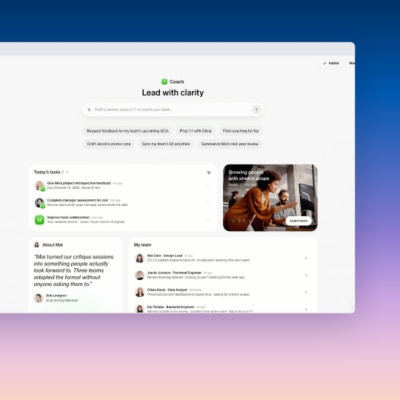
Sana Coach brings performance, feedback, sentiment, and leadership coaching into one connected, conversational experience, moving talent development from episodic HR tasks to always-on guidance. Watch a demo.

:Square?wid=400&hei=400)
There was no top-down mandate, pilot program, or central engineering project. Instead, HR practitioners spotted a friction point in their own workflows and used Sana to fix it themselves.


Labor market mobility may be low, but work inside organizations is changing fast. Our latest Global Workforce Report shows how adaptable leaders can build momentum from within.