Turning AI Hype Into Real World Builds
Walk the DevCon floor with Kainos to see how hackathon momentum, agents, and developers turned Workday’s new developer tools into real builds.

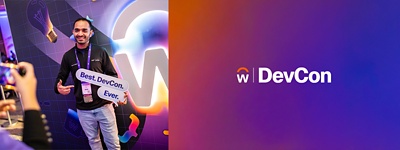
Walk the DevCon floor with Kainos to see how hackathon momentum, agents, and developers turned Workday’s new developer tools into real builds.
Written by Kainos, a Workday partner
In this article we discuss:
By the time the hackathon kicked into gear, Workday DevCon was already in overdrive. Laptops open, conversations turning into whiteboard sketches, and everywhere we turned, people were building real agents, not just watching another demo.
We came to DevCon 2026 as a long-time Workday partner and spent the week shoulder to shoulder with teams trying to connect big ideas to real-world builds. No one stood on the sidelines as developers tested agents and wired up new patterns to see just how far they could push Workday’s new open ecosystem. The result? Real momentum and a palpable shift from experimentation to building the future of enterprise AI.
For our customers, confidently answering ‘can we trust this?’ shifts the conversation to ‘how do we scale this?’
Governance wasn’t an afterthought at DevCon; it was built into the conversation from the start. Security groups, systems of record, delegated execution, auditability: these are the levers that make it possible to move quickly without losing control. For our customers, confidently answering “can we trust this?” shifts the conversation to “how do we scale this?” And, that is what turns interest in agents into live projects.
Workday’s Developer Agent came up everywhere—on stage, in hallway debates, and across the hackathon floor. But what made it stick was what people could actually do with it. Builders started to picture full enterprise applications and agents spun up from natural language prompts inside the tools they already use, shrinking the gap between idea and implementation, and pulling more builders into the process.
In our Build Smarter Agents with Workday Build session, co-delivered with Workday, we stayed close to the questions we’re hearing from partners and independent software vendors (ISVs): how do you build with the Developer Agent, and how does it fit alongside existing Extend orchestration patterns? We unpacked the difference between agents and orchestrated workflows, showing where non-deterministic reasoning adds real value and where deterministic logic still needs to lead. We walked through core pieces like agent definitions and skills, and showed how to wrap external systems into orchestrated actions so they can be safely exposed as tools.
As a result, we moved the conversation from “this is exciting” to “this is how we’d build it for a customer.”
From our perspective, the most important theme of DevCon 2026 was Workday’s move toward a more open developer ecosystem—stronger ties to existing tooling, clearer public documentation and APIs, and an explicit focus on flexibility and connectivity.
That doesn’t make deep expertise optional; it changes where expertise shows up. The real work shifts toward designing robust patterns, setting guardrails, and knowing when an agent is the right fit versus a deterministic workflow.
Many organizations want to move faster but are wary of cutting corners on security or control.
DevCon made it clear that this doesn’t have to be a trade-off. New capabilities like Agent-Ready Tools, Agent Passport, and Data Cloud point toward a development model where teams can prototype and iterate more quickly while staying inside well-defined governance boundaries. For customers trying to scale innovation without creating cleanup work later, that’s a meaningful change.
With natural language-driven tooling and agent-based patterns, developers are no longer constrained by the old enterprise pace. Teams can go from idea to meaningful prototype much more quickly. That acceleration raises the bar on architecture and design discipline: if more people can build, then patterns, controls, and testing matter even more. Fast is good. Fast and repeatable is where value shows up.
Enterprise AI is being shaped by developers who want more openness, momentum, and tools that let them move quickly without losing trust.
That lens is what we’re bringing back to customers now. We see AI moving past experimentation and into measurable outcomes. We see agentic AI folding into everyday processes instead of sitting off to the side as a separate AI project. And we see customers asking sharper questions about value, trust, and how these new capabilities fit into their existing Workday landscape.
We’re investing directly in that future. Through our AI Center of Excellence for Workday, we’re helping customers understand what’s already available in their tenant, what’s arriving next, and which use cases make sense as a first step. Not a 50-page roadmap, but a clear sequence they can act on. Our Workday Marketplace apps and accelerators are designed to reinforce the foundations that matter most in an agentic world: governance, documentation, security, auditability, and testing.
Coming out of the event, the biggest takeaway is that the groundwork for AI tools needs to be laid today. Moving past the testing phase and preparing business systems for this next wave requires clear, immediate actions. This process begins by checking existing software security and management rules, finding slow or repetitive tasks that AI can help automate, and making sure company records are ready to support these new tools.
Ultimately, DevCon 2026 proved that the next wave of enterprise AI is being shaped right now by developers who want more openness, more momentum, and tools that let them move quickly without losing trust. The concrete actions teams take within their organizations this quarter will define how they build alongside Workday and the broader community moving forward. After an inspiring week on the conference floor, it is hard not to head home already thinking about what to bring back to DevCon next year.
More Reading

For years, contract software could only record what people did and wait for them to do the next thing. Now, processes can start taking care of business. Introducing Workday's Contract Workflow Agent.


As enterprise AI transforms global business, true leadership requires turning corporate commitments into measurable, real-world impact across climate, talent, and governance.


Introducing Workday VNDLY Contingent Sourcing Agent: The Next Era of Total Workforce Management
Today, Contingent Sourcing Agent is generally available. It reduces time to fill open contingent worker roles with AI-powered grading and recommendations that improve applicant quality and surface spend optimization opportunities.