Trust at AI Speed: Five Ingredients of the New Workday
Here's how Workday is delivering innovation at full speed without putting core operations at risk.


Here's how Workday is delivering innovation at full speed without putting core operations at risk.
Every week brings another demo of what novel AI can do, and another headline on how it's about to remake enterprise software. Both are true. But what a model can do and what an enterprise needs to operate safely are different.
This scenario is playing out everywhere: a company sets out to modernize with AI and, within months, has 50 agent projects scattered across departments, each one representing someone's good idea. Then, in a single afternoon, leadership cuts the list to 15. Not because the other 35 failed. Most of them worked fine. But they were getting expensive, unwieldy, and they weren't touching the processes the business depends on: payroll, close, talent operations—operations that can't break.
Where experimentation is cheap and abundant, agents are easy to spin up and easy to cut. But core operations are different. Here, AI isn't replacing the software—it's improving its efficacy and impact.
Workday President of Product and Technology Gerrit Kazmaier covered this shift in a recent conversation with Bloomberg’s Anurag Rana on the Bloomberg Intelligence Tech Disruptors Podcast.
Kazamaier says Workday is focused on innovation at full speed, without putting core operations at risk. And it comes down to five key ingredients.
Enterprise software has long meant hunting through menus, tabs, and forms. That era is giving way to natural conversation, the hallmark benefit of AI. At Workday, Sana is the AI surface people talk to. But its real power is behind the scenes—it’s the engine that runs the agents, and the AI platform connecting our entire tech stack.
Sana reaches every Workday customer. It's the horizontal intelligence layer Workday has been building toward—a single interface for asking questions, taking action, and automating work. And it can safely sit in front of everyone because it inherits its permissions, security, and data context from the systems of record its built on.
"The SaaS UIs that we have today will go away because they’re not designed with core intelligence in mind. "
 Gerrit Kazmaier
Workday President of Product and Technology
Gerrit Kazmaier
Workday President of Product and Technology
Precision is the critical advantage. When people call SaaS obsolete, they forget what the core does: run the processes a company cannot get wrong. Here’s an example. An employee moved from Austin to New York in March, has a wage garnishment on file, and just got a raise backdated to January. Correct net pay depends on all of it at once: two tax jurisdictions, the priority of that garnishment, and the retroactive adjustment. "Close enough" means someone's paycheck is wrong and the company is non-compliant.
That exactness is built in by design and encoded across the roughly 80 million users and 1.4 trillion transactions a year that run on Workday. Each one carries its own tax rules, effective dates, and exceptions. A frontier lab can hand you a brilliant model. It can't hand you the twenty years Workday has spent getting people data right.
A frontier lab can hand you a brilliant model. It can't hand you the twenty years Workday has spent getting people data right.
Once an agent performs work rather than suggests it, it must be governed like any other employee. AI governance for our customers is baked into the product. It’s not a feature or a setting. The Workday Agent System of Record is an employee record for agents. Each one gets a verified identity, defined permissions, and a full audit trail—whether Workday, a customer, or a partner built it.
An agent within this system of record acts with exactly the authority of the person behind it. Open on the surface, strict at the core. This allows customers to connect through Teams, Gemini, and open protocols like MCP and A2A. And agents built in Microsoft's Copilot Studio register through Entra Agent ID for one governed view. Each runs inside the same controls. This prevents agent sprawl running amok—ungoverned agents acting on enterprise data with no identity and no audit trail, a shadow ERP no one can unwind.
"The companies doing it the most responsibly, the most securely, the most trusted are the ones who are going to be rewarded with the customer’s vote of confidence."
Gerrit Kazmaier
Workday President of Product and Technology
When one person working with agents can do the work of 10, seat-based pricing stops describing the value, and metering raw tokens makes cost impossible to forecast.
Workday's Flex Credits solve this by tying cost to completed work: companies buy a pool of credits upfront, and credits are drawn down only when an agent finishes a task, weighted by how much work that task actually takes. Usage shows up in real time, so finance can see spend building before the bill arrives instead of reconciling it after.
Pricing this way means thinking in new units. Instead of counting seats, customers work from a rate card that reflects what agents actually complete—a closer match to the value delivered. Industry analysts have noted the shift this represents: moving from a fixed per-employee subscription to usage-based pricing means total spend now depends on how actively agents perform work rather than a stable per-employee figure. That makes day-to-day cost more accurate, and it's why the real-time consumption view matters as much as the pricing logic itself.
The result is a model finance can plan for with fixed numbers, not estimates. And it's one reason Workday’s agentic usage is up sharply year over year.
Time to value and total cost of ownership are critical for any business evaluating new software, especially for mid-sized organizations. Workday's Deployment Agent is already cutting implementation effort by about 30 %—with a target of 50%—making it easy for mid-sized companies to justify the investment. And they get the same reliable platform the largest enterprises run, not a stripped-down version.
Mid-sized companies get the same reliable platform the largest enterprises run, not a stripped-down version.
These five elements are essential to building one connected system: the interface depends on the core beneath it, governed agents are what make that core safe to open to the outside, and consumption-based pricing and faster deployment bring the result to far more companies.
Together, they expand what the software does. For years, Workday has been the trusted record keeper of work, capturing who was hired, what they were paid, and how the quarter closed. Now, it can take on the work itself, starting with the parts that were always drudgery: the gathering, the reconciling, the routing between systems. Agents handle those processes under human direction and safeguards built in, so people spend less time on data entry and more on the judgment only they can provide.
The goal is to free people from the busywork that never needed them, working on a platform so intuitive that using it barely feels like software at all. And all of it is built on the core that already runs HR and finance for many of the world's largest companies.
Check out the full conversation between Gerrit Kazamaier and Anurag Rana on the Bloomberg Intelligence Tech Disruptors Podcast.
More Reading

The opportunity for agentic HR, Finance and IT is so much more than efficiency—it’s about unlocking business growth and reinvention.

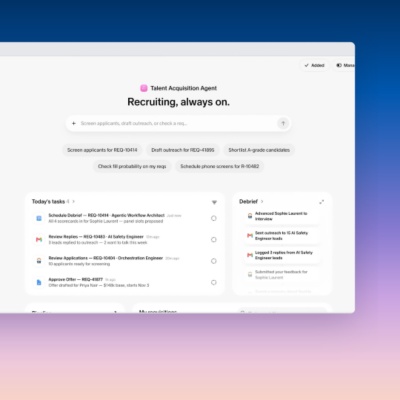
Workday's Talent Acquisition Agent handles routine hiring tasks automatically, keeping hiring moving 24/7. Recruiters spend less time on admin, so they can focus on engaging top talent and making better hiring decisions faster.

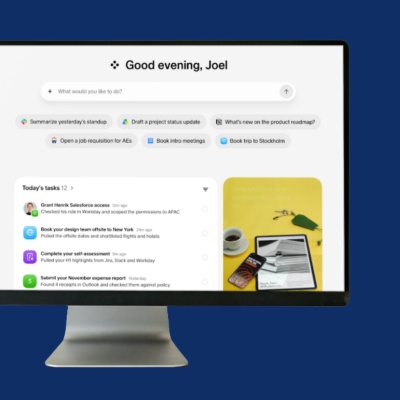
At Workday Rising today, we're introducing new Sana capabilities that help employees get work done across HR, finance, and IT by coordinating the right agents, tools, and people behind the scenes. Watch a quick demo.