Adaptive Decision Intelligence Delivers Free-Form Analysis Across Any Data Set
Adaptive Decision Intelligence delivers conversational modeling and data exploration, breaking the limits of traditional planning environments.


Adaptive Decision Intelligence delivers conversational modeling and data exploration, breaking the limits of traditional planning environments.
For decades, planning technology has been built around the plan. The model, the forecast, the variance report. Software designed to hold and calculate the numbers, not to help people think.
But planning isn't just a numbers exercise. Every CFO knows this intuitively. The best financial plans don't come from better formulas. They come from better conversations between finance and the business, between what the data says and what leaders believe, between what happened last quarter and what needs to happen next. The plan is the output. The real work happens in the thinking.
And yet most planning tools are still optimized for the output.
Adaptive Decision Intelligence is built for the thinking. It gives planning teams a governed, AI-powered workspace for the analysis that has always happened outside the plan, combining data from any source, testing assumptions in plain language, adding dimensions, and comparing scenarios side by side without losing context. The exploration stays structured and traceable from the first question to the final decision.
To understand why we built Adaptive Decision Intelligence, it helps to start with the limits of traditional planning systems.
The best financial plans don't come from better formulas. They come from better conversations between finance and the business.
No one decided that critical business decisions should live in a spreadsheet on someone's desktop. It just happened gradually, then everywhere.
Planning platforms have long suffered from the same constraints. They can't build everything a team needs into one model. A planning model can only answer questions it was built to answer. When an FP&A team needs to go deeper, the analysis has to happen somewhere else. This shifts out of the core system the moment they try to combine financial data with operational data, pull in outside sources, or add dimensions the model wasn't designed to hold.
To manage this, analysts export to spreadsheets. They chase data across systems, build offline models, and stitch together answers that never make it back into the plan. The result is a shadow planning layer disconnected from the governed model, and invisible to the business.
The root cause of this disconnect is structural. FP&A teams don't export to spreadsheets because they prefer working that way. They do it because the planning model can't reach the data it needs, and the data it needs can't reach the model.
That's the problem Adaptive Decision Intelligence solves first. Connecting planning data with data sets across the business does more than give FP&A teams the full picture. It gives AI the same broad scope to draw from and to reason over. And by automatically building a semantic model from the data that defines relationships, hierarchies, and business logic, AI can reason across the data without hallucinating. The model knows what the numbers mean, not just what they say.
And that distinction matters. The quality of every AI answer, every recommendation, every scenario, is a direct reflection of what the model can see. Give it a narrow view and it produces narrow analysis. Give it the full picture with the operational detail, the historical context, the signals that live outside the financial model, grounded in a semantic layer it can reason over, and it produces something fundamentally different.
That’s when the exploration really opens up. If a sales leader wants to add headcount in two markets, finance can model how each hire affects quota coverage, ramp costs, and breakeven timing right there in the meeting. Not a Friday answer to a Tuesday question. The definitive answer, in the room, before the decision is finalized.
New categories of questions become answerable. New opportunities become visible. An analyst can model any number of responses in real time, and Adaptive Decision Intelligence builds the model on the fly, surfacing how each option plays out against revenue, profitability, and the assumptions underneath.
Planning software has always been defined by what it could store and calculate. The next era will be defined by the decisions it helps shape.
Two key problems disqualify AI in a finance context: queries that produce different answers on different days, and ad hoc methodology that no one can defend to a CFO. Adaptive Decision Intelligence addresses both structurally.
AI reasoning is inherently probabilistic. Much like a senior analyst relying on experienced judgment, the system evaluates probabilities to determine what to investigate, how to structure the analysis, and what to surface. But every calculation is fully deterministic. Calculations trace back to the source assumptions by design, so any number on the screen can be easily interrogated, verified, and defended. Same query, same answer, every time.
When the analysis is complete, planners can write that new path directly back to the core planning model. That's a crucial step standalone language models cannot take. Reading from a planning system is straightforward, but enforcing business rules, governance controls, and an audit trail requires owning the planning system of record. It is the difference between intelligence that simply produces an output, and intelligence that produces recorded decisions.
The questions coming at planning teams are getting harder and the windows to answer them are getting shorter. A CFO doesn't want a model rebuild. They want an answer in the meeting. Adaptive Decision Intelligence was designed for that moment. Taking in real-world data on the fly, explaining its reasoning, and producing scenarios in the same conversation where the decision gets made.
There's a quieter shift here too. Planning has historically been the work of a small group of people who know a company's planning dimensional structure well enough to use the system. When anyone can ask the question in plain language, a finance business partner, a sales operations leader, an HR planner, the conversation about what the business should do next gets wider, faster, and better informed.
Planning software has always been defined by what it could store and calculate. The next era will be defined by the decisions it helps shape. By the intelligence that monitors the business as it moves, anticipates what matters, and surfaces what teams need to know before they know to ask. Adaptive Decision Intelligence is how that era starts.
Adaptive Decision Intelligence is available now for early adopter customers and is expected to be more broadly available later this year. Read the full press release to learn more.
More Reading
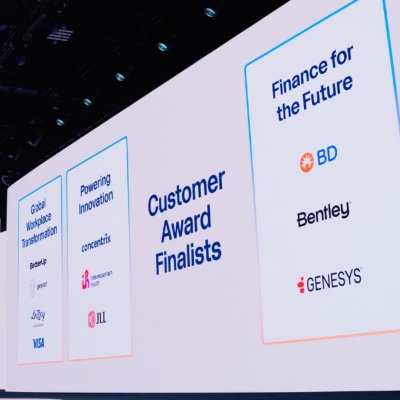
Hear from the leaders behind transformations across HR, finance, and IT about what each award means to them.


The opportunity for agentic HR, Finance and IT is so much more than efficiency—it’s about unlocking business growth and reinvention.

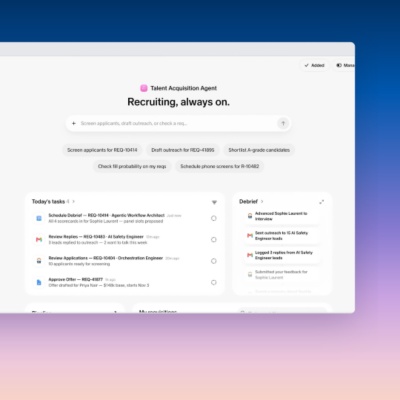
Workday's Talent Acquisition Agent handles routine hiring tasks automatically, keeping hiring moving 24/7. Recruiters spend less time on admin, so they can focus on engaging top talent and making better hiring decisions faster.