Beyond Automation: When Intelligence Catches Up With Work

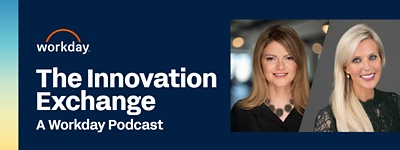
In two new episodes of The Innovation Exchange podcast, Workday's Mark Woollen speaks with leaders from Censia AI and Auditoria.AI about how partner-built innovations are giving HR and finance leaders the contextual intelligence they need to redesign work—and run it—in the AI era.

image alt text here

Pricing models are shifting. Skills are evolving faster than job descriptions can track them. AI is collapsing the distance between asking a question and acting on the answer. For a decade, enterprises invested heavily in speed—and the results were real. But across finance and HR, leaders are now discovering that the systems built to help them move faster were never designed to help them think differently.

That gap—between data and decision, between speed and intelligence—is what two recent episodes of The Innovation Exchange tackle head-on.

For CFOs, that creates a familiar tension: finance teams are asked to close faster, forecast more accurately, manage risk, and somehow also architect AI-driven transformation, all while managing the operations that keep the business running. For CHROs, the equation is just as exposed: do more with less, fill roles, upskill the workforce, and lead the AI conversation across the enterprise.

In these conversations, Mark Woollen, GVP of partner innovation at Workday, speaks with Joanna Riley of Censia AI and Adina Simu of Auditoria.AI about two different but deeply connected realities: workforce intelligence and agentic finance.

Together, the discussions point to a broader truth. Automation made work faster. Intelligence—contextual, governed, and embedded in the system of record—is what changes the work itself.

Workday + Censia AI: Turning the Lights on Workforce Intelligence 

For most organizations, the picture of their own workforce is more limited than they realize. Titles, tenure, and occasional project histories make up the bulk of what HR and business leaders actually see. The capability sitting inside the organization—the adjacent skills, the inferred experience, the trajectory of a career—remains largely invisible.

As Riley, founder and CEO of Censia AI, frames it, this visibility gap is the true constraint on workforce strategy. When the underlying picture of the workforce is static, every downstream decision—internal mobility, succession, workforce planning, and learning investments—inherits that limitation. The same applies to AI. An agent acting on incomplete data produces faster wrong answers, which is often worse than no answer at all.

Censia AI's approach is to provide a "living model" of the workforce: an entity graph built over nearly a decade from more than 550 million professional profiles, structured around the relationships between people, skills, roles, companies, and industries.

That intelligence continuously updates skills in Workday as roles and capabilities evolve, so Career Hub, Talent Marketplace, and workforce planning tools always have current, usable data to draw from. 

The results show up where leaders need them most. Verizon shared at Workday Rising 2025  that after pairing Censia AI with Workday, the company saw a 26% increase in internal mobility, an 82% reduction in unwanted churn across 75,000 employees, and roughly $77 million in ROI in the first year. Riley summarizes the outcome simply:

"We've been operating in the dark, and we finally just turned the lights on."

Joanna Riley CEO and Co-Founder, Censia AI

That visibility is central to how Censia AI approaches workforce intelligence.  With its Job Profile Skills Enrichment Assistant—now available on Workday Marketplace—the goal is to eliminate the manual, reactive work of maintaining role definitions, replacing it with a continuously updated, explainable view of how skills, tasks, and emerging requirements are evolving for each role, with humans firmly in the loop.

It's just one piece of what Censia AI brings to Workday.  Employee Profile Enrichment  is another Censia AI solution that infers a worker's skills from the full arc of their career, going far beyond what most employees would think to self-report, and writes that skills data directly back into Workday.

The analogy Riley returns to is one her customers coined. "Workday is the supercar. Censia AI is the gas to that supercar". The platform was already built for speed. What contextual intelligence adds is direction.

Riley's full conversation with Woollen goes deeper on how Censia AI's entity graph works, why most workforce AI fails without it, and what it actually takes to give leaders a living model of their people. Listen to the full replay.

Watch and listen to this full episode on YouTube, Spotify, or Apple Podcasts.

Workday + Auditoria.AI: From Automation to Autonomous Finance 

If Censia AI focuses on giving HR leaders a clearer view of capability, Auditoria.AI focuses on what happens when intelligence is brought into the day-to-day operations of finance—and what becomes possible when those operations stop being a ceiling on the function's ambition.

Adina Simu, co-founder of Auditoria.AI, notes that finance teams have been promised better automation for 40 years. Each generation of tooling helped, but each hit the same wall: rules-based automation cannot scale across the massive variations of real finance work.

The shift Simu describes is the move from automation to autonomy. AI agents that understand language and context can do more than execute a predefined path. They can read an incoming invoice, evaluate whether the vendor is in good standing, decide how the transaction should be recognized, and—crucially—know when to stop and ask a human for help.

With Auditoria.AI's agentic teammates working alongside the staff through Workday Marketplace apps like SmartVendor AP Helpdesk and SmartResearch, repetitive work is absorbed at the front line.

Operating against a single central source of truth in Workday Financial Management, these Workday agents allow finance professionals to shift their focus toward more strategic, high-judgment problem-solving.

"The work does not become lighter. The work actually becomes denser. They are going to solve problems that maybe in the past they were encountering less frequently."

Adina Simu Co-founder and Chief Product and Commercial Officer, Auditoria.AI

Simu is careful not to oversell autonomy. Trust is the gating factor in every finance deployment, and trust is built in stages. Organizations typically start with a collaborative approach where agents bring decisions to team members for review. Once trust is established, autonomous capability is gradually unlocked.

This unified view of how finance data flows across the organization allows teams to deploy agents as managed identities using the Workday Agent System of Record. The result is that customers can go live in weeks versus months or years, breaking the efficiency ceiling of traditional point solutions.

Adina Simu's full conversation with Mark Woollen covers how trust gets built with agentic finance in practice, what "autonomy in stages" looks like for real finance teams, and why the next generation of finance professionals will solve denser problems—not easier ones.

Watch and listen to this full episode on YouTube, Spotify, or Apple Podcasts.

Why Context Is the New Differentiator

Automation solved for volume. It made transactional work faster, cheaper, and more consistent. But it left a different problem untouched: the gap between what the data says and what a leader actually needs to decide.

That gap doesn't close with more automation. It closes with context—with AI that understands not just the transaction, but the role behind it, the relationship it sits within, the policy it has to honor, and the intent it's meant to serve. That's the shift both Censia AI and Auditoria.AI represent, and it's also why the platform they build on matters as much as the intelligence they bring.

An AI agent operating on incomplete or siloed data doesn't just underperform — it produces faster wrong answers. Governance bolted on after the fact doesn't just create friction — it creates risk. The organizations getting the most from AI-powered finance and HR aren't the ones adding intelligence on top of their systems. They're the ones embedding it inside the system that already holds their trusted operational truth.

For CFOs and CHROs navigating this moment, the question is no longer whether AI will change the work. It already is. The question is whether the intelligence driving that change has the context to be trusted — or whether your teams are still, in Riley's phrase, operating in the dark.

A Platform Built for Trusted Intelligence.

The solutions in these episodes share an important characteristic: they are built directly on the Workday platform. Censia AI's intelligence enriches the employee and job profiles already at the heart of HR workflows. Auditoria.AI's agentic teammates operate as managed identities inside Workday, working against the same financial truth that runs the close, the reporting, and the audit trail.

That design choice means HR and finance leaders can extend Workday with partner-built innovation without introducing parallel systems, duplicated data, or governance gaps.

For CFOs and CHROs being asked to architect the future, the path is starting to clarify. Speed got the enterprise this far. Context—embedded, governed, and trusted—is what carries it forward.

Explore partner-built apps, agents, integrations, and services on the Workday Marketplace.

More Reading