Three Plays for Fostering a Powerful Partnership Between AI and Humans

The growing risk of AI is that employees can prompt algorithms but atrophy the very human skills that enable creativity, collaboration, and critical thinking. These three key plays will help organizations form the foundation for a powerful partnership between humans and AI–creating a symbiotic relationship where technology expands our capabilities and humans continue to grow and make progress.

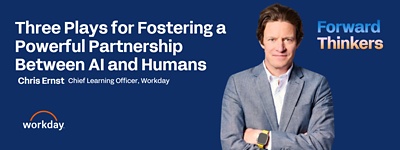
Three Plays for Fostering a Powerful Partnership Between AI and Humans Cheris Ernst, Chief Learning Officer, Workday Forward Thinkers


AI is fundamentally reshaping the workplace, and with it, the very nature of human learning. This transformation has sparked an urgent conversation with my peers in the learning & development (L&D) community. While AI promises a wave of productivity and efficiency unlike anything before, it also poses a significant risk: that we become a workforce skilled in prompting algorithms, but lose sight of how to grow, adapt, and ultimately, drive innovation. 

Since my early career days, the 70-20-10 model has become a widely recognized framework for L&D: 70% of our learning happens through real world experience, 20% through relationships, and 10% through formal training and personal development. When we talk about driving progress in any field—whether it's corporate, non-profit, government—it universally hinges on our unique human ability to continuously learn, grow, and change. 

To foster a powerful partnership between AI and humans, we need three key “plays”: we must reimagine workforce development through experiential learning, strengthen our social connections, and intentionally create space for innovation and growth. 

Reimagining Workforce Development Through Experiential Learning

There’s an old saying that “experience is the best teacher.” I know this to be true because I’ve lived it firsthand. During my first 15 years working in L&D, I had the great fortune to work with true masters in our craft. I contributed to research and practice on the 70-20-10 model not by learning from textbooks and theories, but truly apprenticing through hands-on experience.

One way to enable experiential learning is by leveraging AI capabilities to actively contribute to employee growth and skill development.  

Imagine AI that doesn't just complete a task but also offers opportunities to learn the “why” and “how” behind it. For example, an AI-powered financial analysis tool could not only generate reports, but also provide relevant learning modules explaining the underlying financial principles and how to use the resulting data to make strategic decisions. In other words, the AI tool doesn’t just do the work; it teaches you how the work is done. You’re not just getting an answer; you’re gaining a skill.

By leveraging AI for learning and growth opportunities, we fundamentally transform passive interactions into active, real-time learning experiences, making skill development an integrated part of daily work.

Beyond automation, AI can also be designed to provide real-time feedback and guidance, acting as a virtual coach that helps employees sharpen essential skills. For instance, if an employee receives feedback during a performance review about capabilities that need to be improved, AI could proactively offer upskilling ideas—perhaps suggesting training on complex decision-making or effective communication—and even regularly check in with the employee, asking, “What skill do you want to learn today?”

By leveraging AI for learning and growth opportunities, we fundamentally transform passive interactions into active, real-time learning experiences, making skill development an integrated part of daily work.

At Workday, one of the ways we create opportunities for direct, hands-on experience is through gigs. These are short-term, project-based assignments outside of an employee’s core role, which provide a tangible mechanism for experiential learning. These gigs allow individuals to develop new skills, apply their existing knowledge in different contexts, and build valuable internal networks, embodying the “doing” and “connecting” aspects of the 70-20-10 model. 

Strengthening Social Connections

Humans are inherently social beings; we learn, grow, and innovate with others. This emphasis on relationships accounts for 20% of the 70-20-10 model and represents a vital component of human development. What happens, then, when technology begins to separate us from one another—breaking down the vital connections that allow junior workers to learn from senior ones, and novices to apprentice with experts—potentially leading to isolated and fragmented workforces?

The answer isn’t to slow down tech adoption, it’s to double down on connection. Cultivating an environment rich with social connection hinges on foundational elements: trust, collaboration, and shared values. When these are prioritized, they naturally lead to the kind of informal interactions that spark new ideas and strengthen culture. For example, at Workday we intentionally design moments to come together—whether it’s through our EverydayAI event and promptathon, which fostered collaborative learning and encouraged employees to design innovative AI prompts to use in their daily work, or the People Leadership Summit, which brings all our first-time people leaders together annually to learn and connect with each other.

The answer isn’t to slow down tech adoption, it’s to double down on connection.

It's within this context of human connection that we see the true value of our uniquely human skills emerge. This is supported by our research, which found that uniquely human skills like empathy, creativity, complex communication, and emotional intelligence will be the differentiating factors in the future of work. In fact, 83% of respondents agree that AI will elevate the importance of uniquely human skills and enhance human creativity. 

In moments of genuine human interaction—the impromptu brainstorms, the empathetic conversations, the shared successes and challenges—a workplace can truly thrive. 

Creating Space for Innovation and Growth

While 90% of learning happens through experience and relationships, the remaining 10%—creating time and space for learning—is small in percentage but mighty in impact. True learning agility, defined as the ability and willingness to learn from experience and apply those lessons to succeed in new situations, fundamentally requires slowing things down. It's next to impossible to create a new strategic direction, question current assumptions, or envision a future distinct from the present when there’s no time to think.

This presents a critical question: as AI frees up human capacity, how will it be reinvested? In the AI era, learning will be just as much about subtraction—challenging one’s current mental models, questioning assumptions, and letting go of old ways of being and doing that no longer serve—as it is about adding new capabilities. As Einstein famously said, “We cannot solve problems at the same level of thinking that we were at when we created those problems.” It is through opportunities for deep work—blocks of focus time each week—and creating “slack” time where workers have autonomy over how best to use their skills and talent, that will enable us to focus on more strategic work and stimulate novel ideas.

It's next to impossible to create a new strategic direction, question current assumptions, or envision a future distinct from the present when there’s no time to think.

Beyond dedicated time, we also need to offer educational or training experiences that provide new knowledge not attainable in our day-to-day jobs. Many of our best ideas and insights occur when we’re not actively focusing on a specific task. Humans are often more capable of creative problem-solving, making connections between diverse ideas, and gaining new perspectives when the mind wanders freely. Organizations can facilitate these “Eureka” moments through offering experiential workshops, curating intentional moments for out-of-the-box brainstorms, or personal development training that give space for the brain to “work” in a different way. 

A New Path Forward

The future of work is not a zero-sum game between humans and AI. It is an opportunity to create a symbiotic relationship where technology expands our capabilities and humans continue to grow and make progress. This is not just a technological transformation; it is a human one. 

True learning, growth, and adaptation come from doing the work. It's through writing the book, solving the complex problem, or navigating through conflict that we truly learn and evolve. It’s in these moments of hardship, challenge, and struggle that people grow and change most profoundly.

It is this nature of human learning—forged through experiences, relationships, and reflection—that forms the very foundation for a powerful partnership between humans and AI. By centering our efforts on this partnership, we can unlock a future of unprecedented productivity, innovation, and fulfillment. 

We surveyed 2,500 full-time workers across 22 countries to explore how AI is reshaping the workforce and the skills organizations need to succeed. Gain their insights now.

More Reading