In the AI era, the hero isn’t the system. It’s the person using it—making decisions, leading teams, and carrying responsibility. That’s why human-centered AI can’t just be a principle, it has to be a design choice: where intelligence shows up, what it takes on, and how it supports people in the flow of work. Done well, AI strengthens judgment and trust becomes part of how it scales.

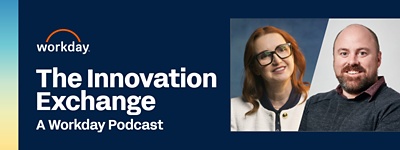
That idea sits at the heart of two recent episodes of The Innovation Exchange, a new Workday podcast series focused on partner-led innovation. In these episodes, Mark Woollen, GVP of partner innovation, speaks with leaders from Cloverleaf and Kainos about what human-centered AI looks like in practice.

Together, the conversations explore two sides of the same enterprise reality: development that supports people as they work, and governance that makes progress safe, auditable, and sustainable.

Workday + Cloverleaf: Coaching in the Flow of Work

For many organizations, learning and development still sit outside the rhythm of daily work. Coaching is often episodic, resource-intensive, and limited to a small group of senior leaders.

As Darrin Murriner, co-founder and CEO of Cloverleaf, put it, “Historically, coaching was really only accessible to the top one to three percent of people in an organization.”

Watch and listen to this full episode on YouTube, Spotify, or Apple Podcasts.

What stayed with Murriner from his own leadership experience was how consistently outcomes came down to the everyday interactions that shape trust, performance, and momentum. Yet, most development models struggle to show up in those moments in a lasting way—the everyday one-on-ones, feedback conversations, and team interactions where trust and performance are built. Traditional training, he noted, fades quickly:

“Within the first day you forget about 70% of what you learn. And by the end of a week, you’ve forgotten more than 90% of what you learned in those sessions.”


Darrin Murriner co-founder and CEO Cloverleaf

Cloverleaf’s response was to rethink where employee development belongs. By embedding behavioral insight directly into the Workday platform, guidance becomes contextual rather than theoretical. It appears close to decisions, conversations, and collaboration—where it has a chance to stick.

Cloverleaf’s Marketplace app, Cloverleaf: Assess, Coach, & Connect, runs directly on the Workday platform. What people experience is not another “AI tool,” but a subtle shift in how work conversations happen with more awareness, intention, and follow-through.

Workday + Kainos: Compliance without the Chaos

Human development, however, is only one side of the equation. As organizations embed more intelligence into core systems, trust becomes the quiet prerequisite for everything that follows.

In this episode, Amanda Monrad, head of product at Kainos for its smart audit suite, turned the focus to an area that rarely draws attention until something goes wrong: user access reviews.

Watch and listen to this full episode on YouTube, Spotify, or Apple Podcasts.

“I think in a nutshell, it is universal. It’s a very common internal control to protect the security of the products that we have, the systems that we use.”


Amanda Monrad Head of product Kainos

Despite their importance, access reviews are often manual, fragmented, and disconnected from the systems they govern. Managers are asked to approve access without enough context. Auditors are left reconstructing decisions long after the fact.

The consequences are real. “It’s something that at its core can result in breach,” Monrad said.

What stood out in the conversation was not a desire to automate judgment away, but to support it better. Kainos focused on redesigning access reviews so they happen where work already happens—inside Workday—with context built in and evidence captured as part of the process.

Kainos’ Marketplace app, Kainos User Access Review, is designed to make access review feel like part of everyday work rather than a separate compliance exercise. Reviews arrive through familiar Workday experiences. Decisions are easier to make because the right information is already there.

“When we’re giving demos of this product to customers, one of the reasons it’s so delightful is because you would never know all of that in the background. It feels like a SKU that Workday has developed themselves.”

In this model, governance doesn’t slow work down, it makes confidence possible.

AI that Supports Judgment

Across both conversations, a shared philosophy emerges: the most effective uses of AI don’t remove people from decisions, they give people better context for making them.

Murriner explained where value is created at work, based on his own experience. “The value that we created for our organization was really all centered around how people work together to create that value.” That belief underpins Cloverleaf’s approach: AI not as a director of behavior, but as a quiet guide in moments that matter.

In compliance, the same principle applies. As Monrad put it, “It’s less about doing the work for an auditor or doing the work for a compliance professional. And it’s more about context.”

In both cases, intelligence works best when it amplifies what people already do well: reasoning, empathy, leadership. Automation handles the friction. Humans handle the meaning.

The most effective uses of AI don’t remove people from decisions, they give people better context for making them.

A More Grounded Path Forward

Human-centered AI isn’t a slogan, it’s the result of thousands of good design choices and the discipline to keep making them as AI scales across the enterprise.

The perspectives shared in these episodes of The Innovation Exchange point toward this path. And in the Workday economy, partner-led innovation plays a critical role—not by adding noise, but by expanding the platform in ways that respect and enhance how people actually work.

When intelligence in the flow of work is matched with governance that scales quietly alongside it, organizations don’t have to choose between innovation and control.

They can move forward with both.

Explore more partner-built apps, agents, integrations, templates, and services on Workday Marketplace—designed to enhance and help you do more with the Workday platform.

More Reading